
Inflation, The Second Wave: PPI, CPI, and The Coming Fed Rate Cycle

Views From the Stream
Inflation, The Second Wave: PPI, CPI, and The Coming Fed Rate Cycle
For those of us who remember the 1970s, the Inflation was insidious. What started as a price spike in Energy, bled into every other area of the economy. For Energy stands the lifeblood of the Global Economy. Everything ultimately derives from energy applied in a specific manner regardless of what new technologies come along. Every good or service ultimately originates in the application of energy: food, gasoline, chemicals, consumer products, industrial products, transportation, electricity, technology components, computers, compute capacity, telecom, solar power, commodities, … And when the price of Energy rises in a fundamental manner, then the price of everything else in the economy inflates. Even food whose short term swings are derived from annual crop production depends on energy to power the tractors, irrigation systems, fertilizer mining, fertilizer processing, food processing, grain transportation, … to deliver food to the world.
Today looks very similar to the setup in the 1970s Inflation. There exists an Energy Shock. Manufacturers initially assumed that the Shock stood a short term phenomenon and Energy Prices would return to their former levels. Unfortunately for the Global Economy, the reality appears a permanent shift upward in the Cost of Crude Oil, with the price now ranging from $70 to $100 per barrel. In addition to this fundamental shift, the War in Ukraine continues to impact the availability of critical Oil products, such as Diesel Fuel, where the price premium to Crude stands at record levels. This would reinforce Wars traditional role in causing Inflation as the means of production become destroyed constricting Supply across various goods. At the same time, Wars traditionally raise demand for Commodities, increasing their prices. On top of all of this stands a major Global Investment Cycle into Artificial Intelligence, which adds additional Demand drivers to the Global Economy.
While the obvious place to start stands Energy, one can see the impact of these combined forces broadening and reaching across all parts of the Global Economy. At a fundamental level, Commodity Prices reflect this underlying dynamic, as the CRB Index (Commodity Research Bureau) demonstrates:
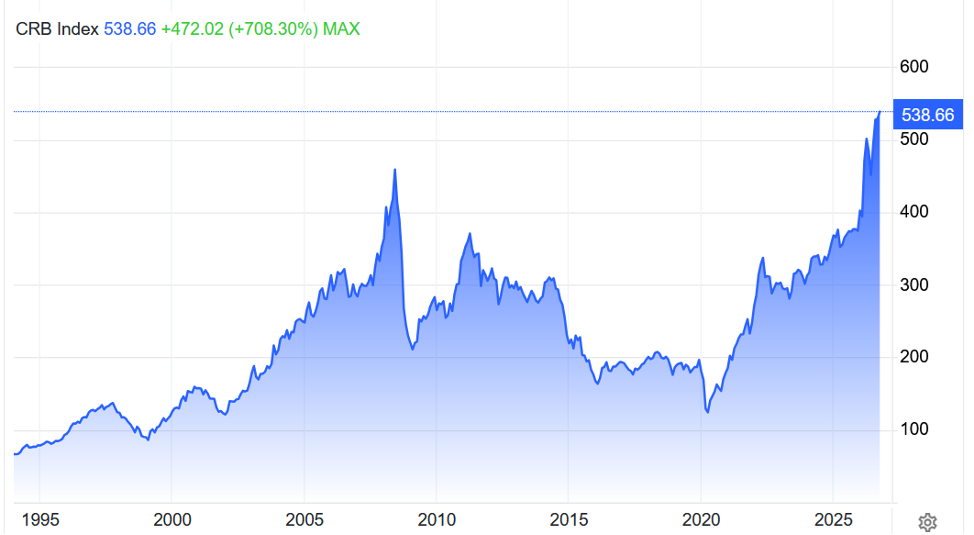
Chart courtesy of www.TradingEconomics.com.
As the Chart illustrates, the CRB Index exceeded its 2008 peak. This increase naturally flows through to the Producer Price Index (PPI) as the following chart of Year Over Year (YOY) Changes demonstrates:
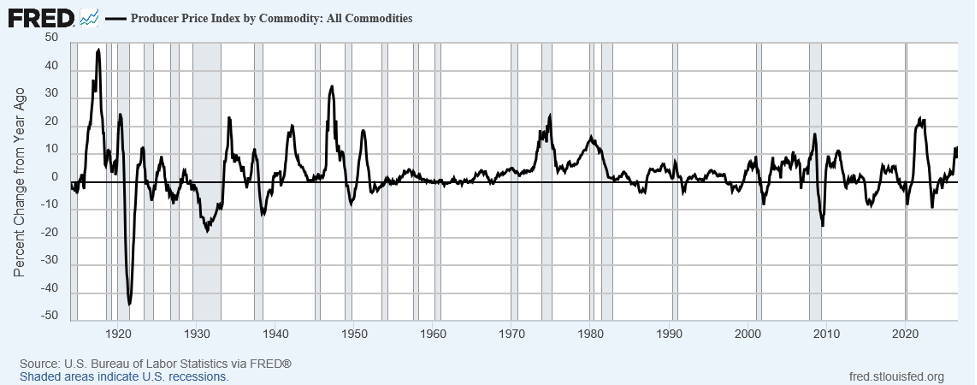
The magnitude of the PPI rise resembles that last seen during the 1970s. To see how this impacts the average consumer, one need only look at the prices of everyday things. Healthcare costs are projected to rise significantly in 2027 after rising 6.4% Year Over Year in the latest 2026 Employment Cost Index. Private health insurance is estimated to see its costs rise 8% – 10% next year, as employers face rising costs. This excludes the rising deductibles they also likely will implement to ameliorate the increase in premiums. For the U.S. Government related programs, Exchange premiums are rising 13%+ for 2027. This adds to the 26% rise seen this year. And maximum out of pocket expenses are rising by 13%+ to $12,000 for individuals and $24,000 for families. On the Medicare front, while Medicare Part B Premiums are rising only 3.3%, Part D and Part G premiums are rising 6% and 10%+ respectively. At the same time, the government raised the maximum out of pocket for Part D Prescription Plans from $2,100 to $2,400 or by 14.3%. And since Part D and Part G Premiums represent more than half the cost of Medicare, it appears that Medicare Healthcare Inflation will run between 6% and 7%.
As to goods prices, Goods manufacturers continue to plan to pass through cost increases in 2027. This pass through spans the gamut from manufacturers of ball bearings to carpets to tires to siding to clothing. All of these industries have seen companies announce price increases of 3% to 7%. For electronic goods, consumers face much higher increases as the cost of memory and other components continues to get passed through to the end user. These price increases can range from 10% to 20%. Trucking companies, who already were raising prices, announced they would add fuel surcharges to make up for the rise in the price of diesel.
And for services, prices continue to rise as well. Whether for simple things such as a going to the hair salon for women to more demanding needs such as hiring a repairman to work on a plumbing issue in a house, prices continue to rise at a rapid clip. Even simple things such as taking clothing to the local cleaner face price increases of 10% to 15%. And other services, such as airline flights, show prices are up 20%+ for a seat this year with more price increases on tap for next year. And while Rental Rates have decelerated over the past three years, as the market absorbed the massive supply put into construction when rates were low, which benefitted reported Inflation figures, Rental Rate Increases likely have bottomed as new Supply collapses. Should the economy continue to grow, Vacancies should gradually drop and Rental Rates should rise at an accelerating pace as Supply and Demand comes into balance. On the Home Ownership front, according to the latest Case Shiller data, Home Prices rose 2.7% YOY for their 20 City Composite despite the low level of Housing Turnover and high Mortgage Rates. The government reported the CPI up just 3.7% YOY in its latest release for September 2026. However, it stands hard to believe based on everyday prices. (For those who like to study arcana, such as government statistics, one can seek to reconcile how adding up the monthly increases over the past year would produce a figure of 4.2% compared to the 3.7% reported by the government statisticians in the latest release.)
With Inflation pushing through the system, can a Rate Hiking Cycle by the Federal Reserve stand far behind? Certainly, prior to the 2010-2020 period, the Federal Reserve acted aggressively to slay Inflation when it reared its head, in order to avoid a repeat of the 1970s. It appears that the Federal Reserve in ignoring Inflation earlier this decade set itself up for a repeat of that era. And while Chairman Warsh certainly talks tough when it comes to Inflation, his actions stand in contrast to his words. Since Kevin Warsh became Chairman of the FOMC, the Federal Reserve raised rates just once and only by 25 basis points. As the following chart makes clear, typical Hiking Cycles see Interest Rates raised by 300 – 400 basis points, excluding the cycles in the 1970s and early 1980s:
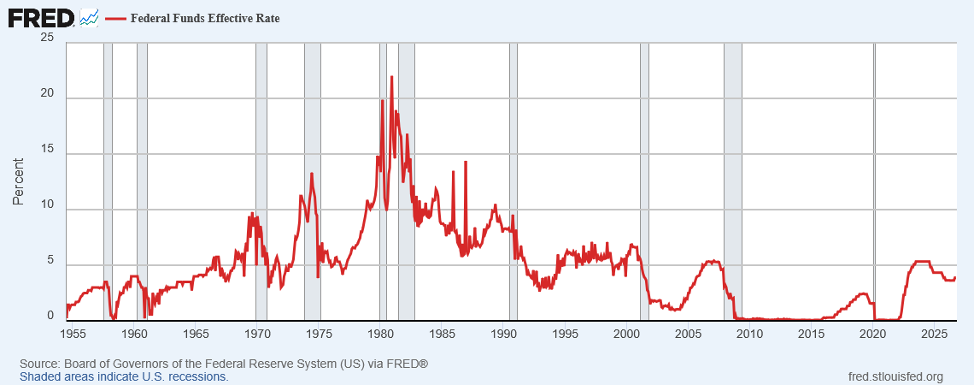
While Kevin Warsh continues to walk a fine line between Fed credibility and President Trump, how long will the markets provide him a pass? Should Chairman Warsh raise rates in a typical Rate Hiking Cycle, President Trump likely would resume his bashing of the Fed. Should Chairman Warsh not act to stem Inflation, the markets would likely react in a negative manner. In some sense, the Federal Reserve remains caught between Scylla and Charybdis. (For those interested in Greek mythology, both Odysseus and Jason and the Argonauts needed to navigate this perilous passage.) While some would argue rates rest at high levels, the Real Fed Funds Rate appears at a level that historically represents a launching pad rather than a peak:
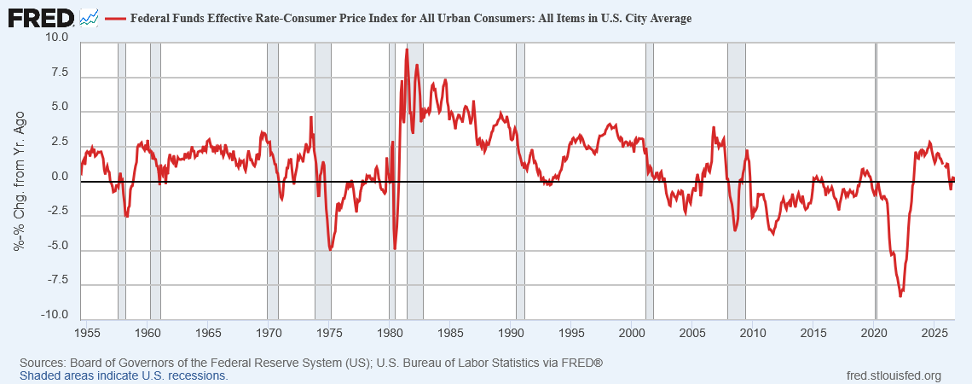
Given this and the likelihood that Core Inflation, ex Food and Energy, will accelerate next year as Rental Rates and Healthcare both move higher along with continuing price increases in Goods and Services, the Fed may have little choice but to raise rates at a pace that few in the financial markets today can envision. And while Oil prices may head lower next year as the Iran conflict gets resolved, prices for Natural Gas sit at low levels, down 10% YOY, and easily could ratchet upward in 2027. Given their impact on commercial and residential electric prices and heating, they could offset any savings to the consumer from lower gasoline prices.
For the U.S., the Inflation story continues as the environment resembles the 1970s period. The PPI remains elevated. And the flow through effects into the CPI remain ahead for the U.S. economy. Adding to this pressure on Inflation, there appears little appetite in Congress to address the massive budget deficits that the U.S. Government continues to run. And while AI Data Centers appear at the mercy of politics, oftentimes, the political bark is much bigger than the bite. And once the election is over, a compromise that serves all parties will likely occur. For the Federal Reserve, as CPI Core Inflation accelerates, a hard choice lies ahead: to enter into a Hiking Cycle or to give in to political pressures. Given the reacceleration in Employment, the likely reacceleration in Wages with a lag, the push by companies to raise prices across the board, and the likely reacceleration in Core CPI, the odds of the Fed entering into a substantial Hiking Cycle to combat Inflation continue to rise. In such a scenario, rates would need to rise 2.50%+ to create tight conditions that slow Inflation, bringing rates to 6.75% or more. Such Interest Rates stand out of view for most consumers and businesses as well as the Equity Markets. But they would merely represent a return to the 1990s levels with room to spare compared to the 10%+ levels reached in the 1970s. With Core Inflation set to accelerate, Caveat Emptor rings as the motto that overhangs business, the consumer, and the U.S. Economy as The Second Wave of Inflation comes to dominate and reverberate through the land.
Recent & Upcoming Travel
During October, I spent much of the month on the road. First, I had the good fortune to travel to Park City, Utah. It is a beautiful setting near Salt Lake City, yet far enough that the mountain scenery dominates the landscape. It appears the economy in and surrounding Park City as well as Salt Lake continues to boom given the massive number of construction cranes I observed. Utah, besides the beneficiary of wealth discovering its magnificence, appears to be attracting significant investment into technology as well. Companies such as Texas Instruments are building major facilities in the state. Second, I had the good fortune to attend a conference in Napa. Besides good wine, it was an opportunity to meet with other family offices to hear about their latest investments and the issues they face. It was quite informative. In addition to the travels on a plane, I also spent quite a bit of time in New York City. The city appears to continue to weather the action of Mayor Mamdani. However, the longer term impact remains to be seen as investment into the city is discouraged.
As to fishing, I had the good fortune to spend half a day in Park City on the Middle Provo River. For just three hours of fishing, I put 5 fish on a hook and landed 3 in the net. Not bad given how little time I have had on the stream this year and given the barbless hooks we were using. I also got a chance to cast a rod for ten minutes for a total of five casts at one of the ranches where the meetings with other family offices occurred. I managed to land and net a fish on my fifth and final cast. A bonus for the week. Latin Social Dancing moved indoors with the weather over the past month. And it remains in full swing with multiple choices every weekend. It continues to occupy at least one of my weekend nights. As to Pickleball, all the travel cut down on my ability to get on a court more than once a week. I am hoping to squeeze a second session in during the coming weeks when I am home.
With that, we will report back next time on our future travels, new hobbies, and fishing tales, providing color on the happenings in the U.S. and around the globe.
Yours Truly,
Paul L. Sloate
Chief Executive Officer